Behavioral interview questions for remote marketers, from a psychologist
Technical skill gets a media buyer hired. Behavior decides whether they last in a remote team. Nine questions that show both.
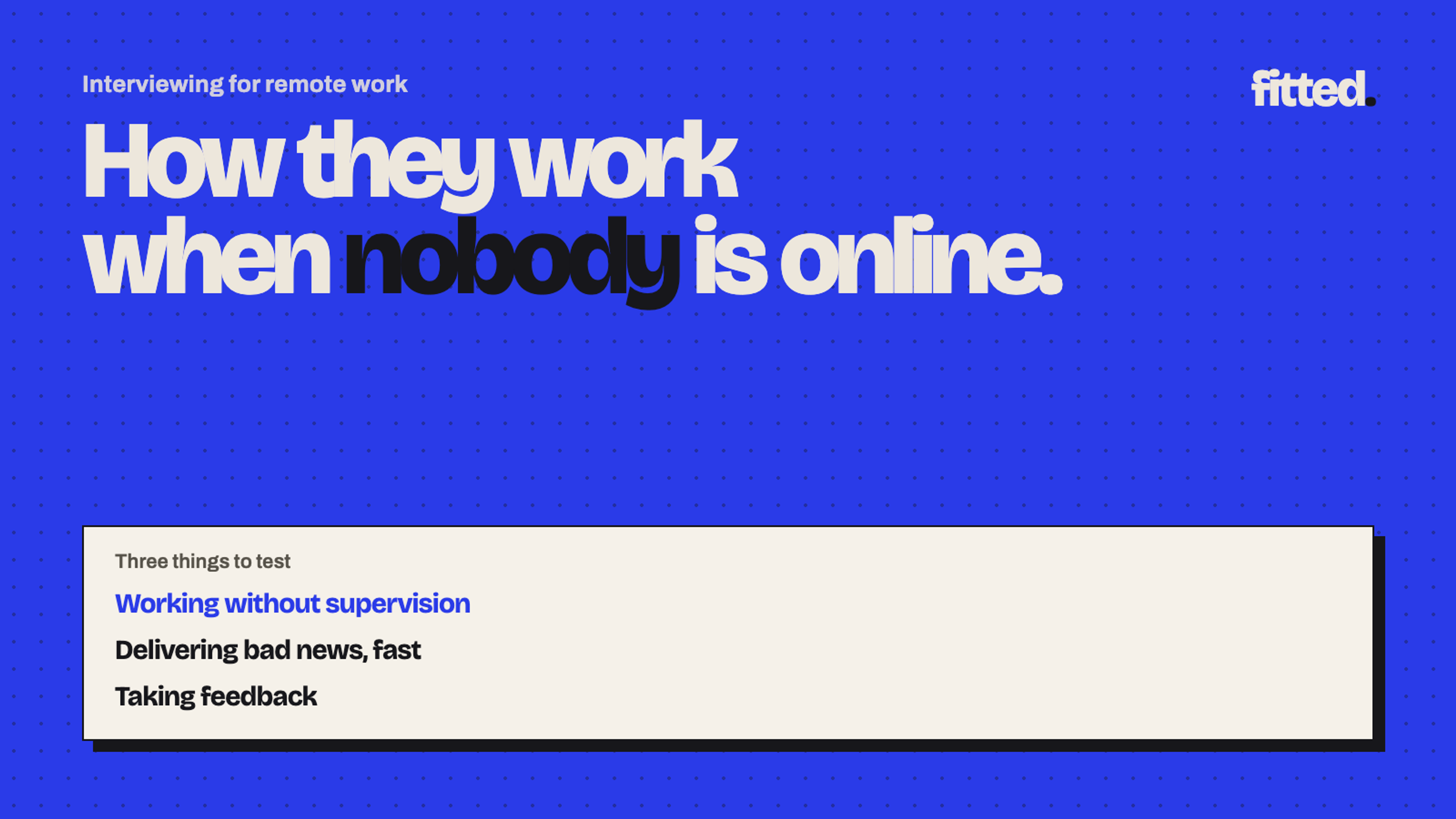
Behavioral interview questions for remote marketers should ask about real past situations: a week when results dropped, a time they disagreed with a manager, a moment they had to decide alone. Past behavior in a specific situation is a better guide to future behavior than any hypothetical. For remote roles, focus on three things: working without supervision, communicating bad news and taking feedback.
I run the behavioral part of our assessments at fitted. These are the questions I find most useful for paid media and performance marketing roles, and what I listen for in the answers.
Why do behavioral questions matter more for remote roles?
In an office, problems surface on their own. A manager notices someone is stuck, overhears a frustrated call or sees that a campaign launch slipped.
Remotely, almost nothing surfaces unless the person brings it up. That means the habits you most need to know about are the ones you cannot see: do they flag problems early, do they ask for help, do they keep working well when nobody is watching.
Technical interviews do not test this. A candidate can be excellent in the ad account and still go quiet for three days when results fall.
How should you ask behavioral interview questions?
Ask for one specific situation and stay with it. The structure psychologists and recruiters use is simple: situation, what they did, and what happened. It is often called the STAR method, for situation, task, action and result.
Three rules make it work:
- Ask for a real example. "Tell me about a time when" is better than "what would you do if".
- Ask follow-ups. "What did you do next?" and "What did you say exactly?" move past the polished first answer.
- Listen for "I", not "we". "We decided" is fine in a team, but you need to know what the candidate did.
What are the best behavioral interview questions for remote marketers?
| Area | Question | What a strong answer includes |
|---|---|---|
| Working alone | "Tell me about a time results dropped and nobody was available to ask. What did you do?" | A decision, a reason and a message to the team afterward |
| Bad news | "Describe the last time you had to tell a manager or client that results were bad." | Speed, honesty and a plan, not excuses |
| Feedback | "Tell me about feedback on your work that you disagreed with." | Listening first, then a reasoned response |
| Prioritizing | "Tell me about a week when you had more to do than time. How did you choose?" | A clear method, and telling people what would slip |
| Mistakes | "What is a mistake that cost money, and what did you change after?" | Ownership and a concrete change in process |
| Disagreement | "Describe a time you disagreed with a strategy you were asked to run." | Raising it clearly, then committing or escalating |
| Asking for help | "When did you last get stuck? How long before you asked someone?" | Asking early, with context prepared |
| Learning | "What is something you taught yourself in the last year for work?" | Curiosity and a real application |
| Async communication | "How do you keep a manager updated when you work in different hours?" | A routine, not "I just message when needed" |
You will not have time for all nine in one interview. Pick four or five that match the role. For a client-facing agency role, bad news and disagreement matter most. For an in-house role with little supervision, working alone and asking for help matter most.
What should you listen for in the answers?
Three things tell you more than the story itself.
Specificity. A real memory has details: a date, a number, what someone said. Vague, general answers often mean the candidate is describing what they think they should do, not what they did.
Ownership. Notice whether problems are always caused by someone else: the client, the platform, the previous agency. Everyone faces those, but strong candidates also say what they could have done better.
Timing. In remote work, when someone speaks up matters as much as what they say. "I told my manager the same morning" is a very different answer from "I waited until the monthly report".
Are there red flags in behavioral answers?
A few patterns are worth a follow-up question:
- No example of a mistake, or a "mistake" that is really a strength, like working too hard.
- Every conflict ends with the candidate being proven right.
- Long delays before telling anyone about a problem.
- Strong discomfort with any feedback, even in the retelling.
One of these alone is not a reason to reject someone. Interviews make people nervous, and some cultures are more reserved about discussing mistakes with a stranger. Ask again in a different way before drawing a conclusion.
Do behavioral questions work across cultures?
Mostly, yes, with some care. Candidates from Brazil, Colombia and Argentina generally answer these questions well, but some people are less used to talking about themselves so directly, especially in a second language.
Two things help. Explain why you ask: "I want to understand how you work when we are not online together." And give the candidate a moment to think. A pause before the answer is not a bad sign. Our post on English level for remote marketing jobs covers how to separate language from substance.
How do behavioral and technical interviews fit together?
Run them separately if you can. The technical interview tells you if the person can do the work. The behavioral interview tells you how they will do it with your team.
Combining them in one hour often shortchanges both. Use our media buyer interview questions for the technical part, then a 30 to 45 minute behavioral conversation.
How we run behavioral assessment at fitted.
Every candidate we shortlist goes through a behavioral assessment as well as a technical interview with a performance marketer. I look at how they work alone, how they communicate problems and how they take feedback.
What I find goes into the written scorecard you receive, in plain language, so you know what kind of management will get the best out of each person.
FAQ
What are good behavioral interview questions for remote marketers?
Ask for real examples: a time results dropped with nobody to ask, the last time they delivered bad news, feedback they disagreed with and a mistake that cost money.
What is the STAR method?
A way to structure behavioral answers: situation, task, action and result. It helps you get specific examples instead of general statements.
How many behavioral questions should I ask?
Four or five, chosen for the role, in a 30 to 45 minute conversation. Use follow-up questions to get past the first answer.
What is the biggest red flag in a behavioral interview?
A pattern of waiting a long time to tell anyone about a problem. In remote work, that habit is very costly.
Isadora Teodoro. Psychologist and recruiter with in-house and freelance HR experience. Runs talent mapping, screening and behavioral assessments at fitted. Published .
Related posts
How to interview a media buyer when you are not one
Seven interview questions that show whether a media buyer actually ran the accounts on their résumé, with what a strong answer sounds like.

How to write a media buyer job description that attracts senior candidates
Most media buyer job descriptions list tools and skip the job. A template that tells senior candidates what they will own, spend and decide.
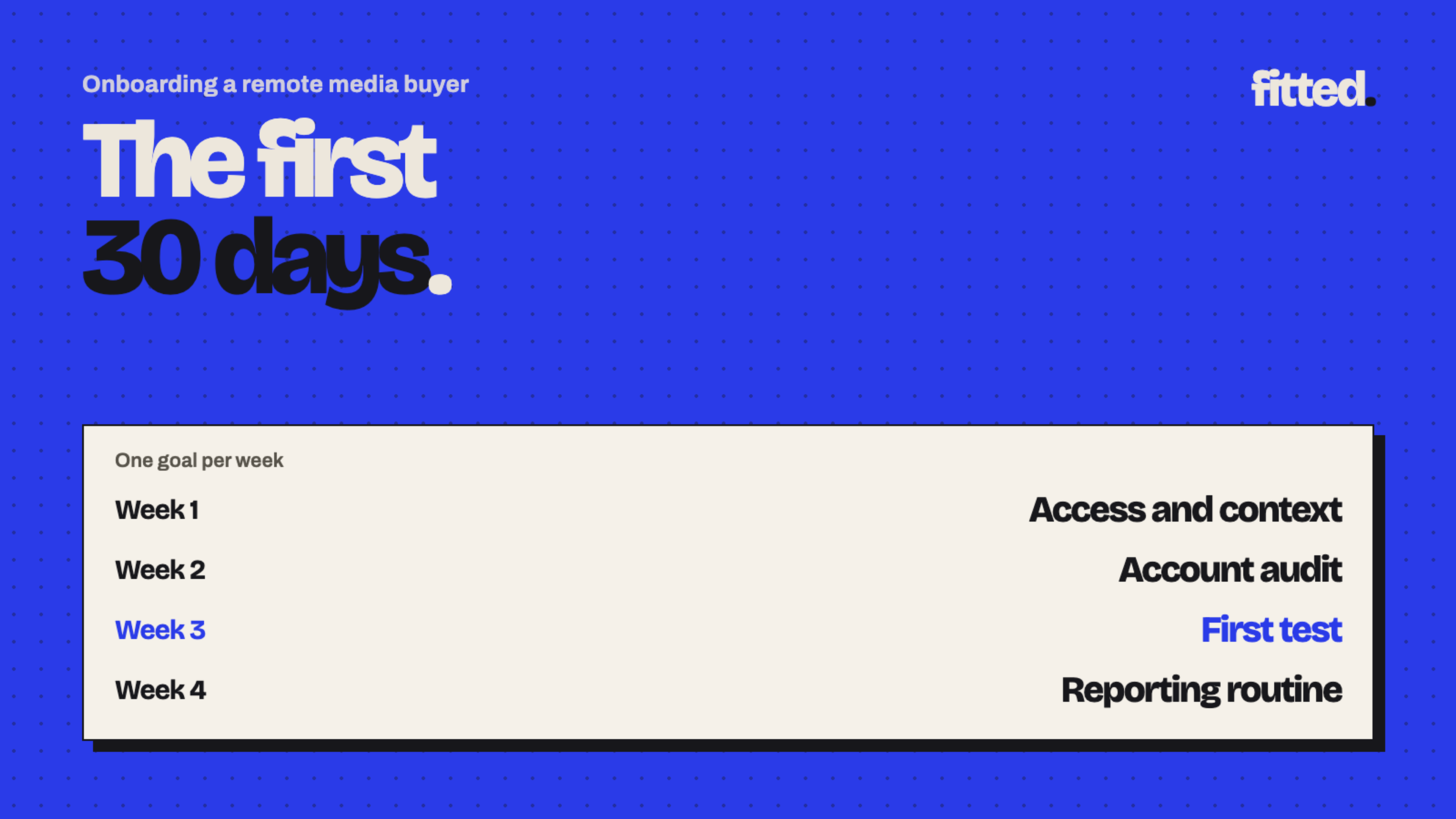
Onboarding a remote media buyer: the first 30 days
The hire is done. The next 30 days decide whether it works. A week by week plan with access, audit, first test and reporting.