How to interview a media buyer when you are not one
Seven interview questions that show whether a media buyer actually ran the accounts on their résumé, with what a strong answer sounds like.
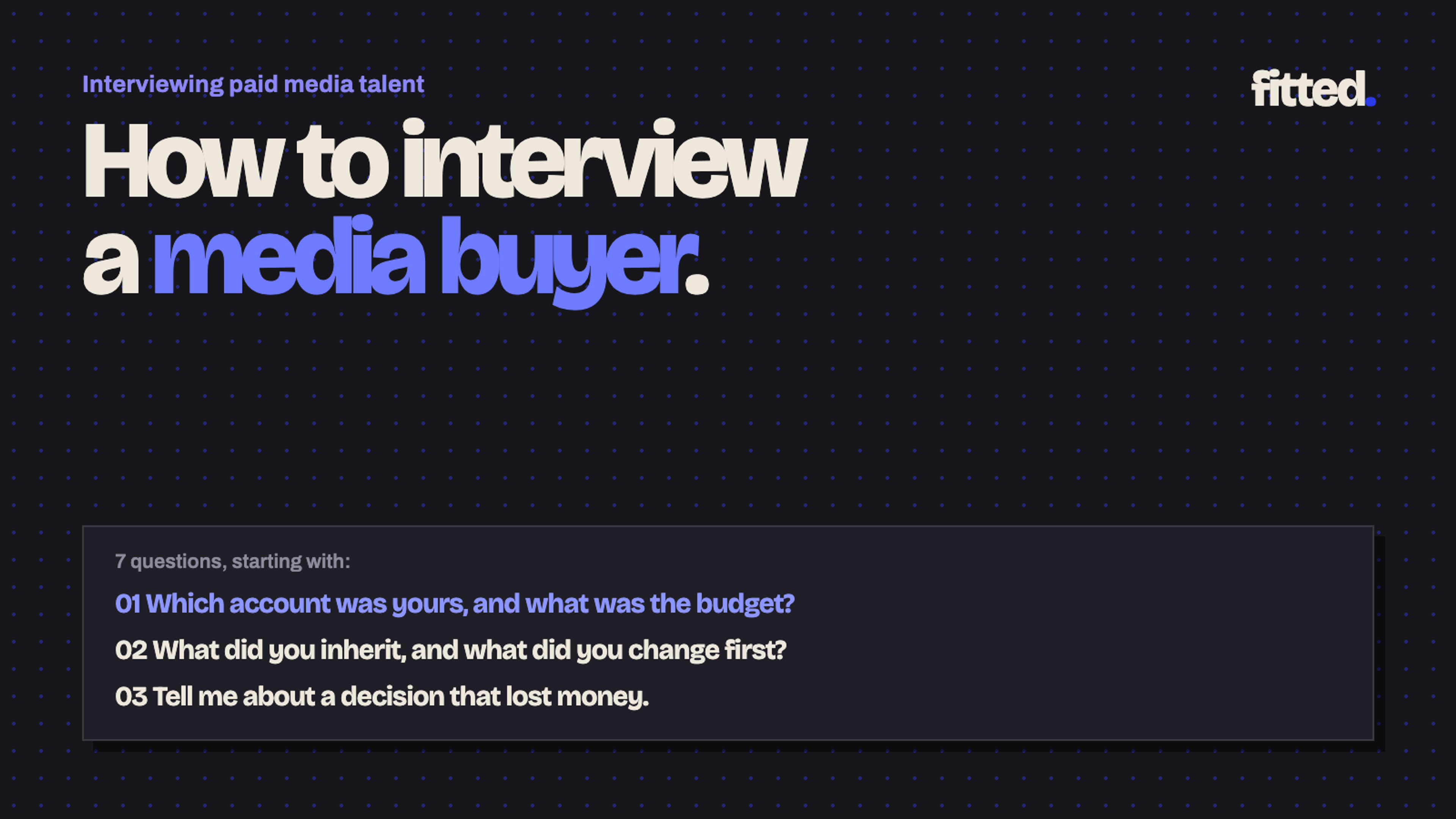
Most hiring managers can't tell a great media buyer from a confident one in 45 minutes. These seven questions can. If you want to know how to interview a media buyer without being one, stop asking about tools and ask about decisions: what they owned, what they spent, what they tested and what they would do differently.
The questions below are the core of the interview we run for every candidate at fitted. You can use them as they are. Each one comes with what a strong answer sounds like and the red flag to listen for.
Why is it hard to know how to interview a media buyer?
Paid media is full of shared credit. A campaign that worked usually had a strategist, a creative team, a client with a good product and a media buyer. Everyone on that team can describe the result.
Very few can describe their own part of it. That is the gap your interview has to close.
The second problem is vocabulary. A candidate who says "CBO", "broad targeting" and "creative fatigue" sounds senior. Those words take a week to learn. The thinking behind them takes years.
So the goal is not to test whether they know the terms. It is to make them walk you through real choices, in order, with numbers.
What are the best media buyer interview questions?
These are the seven we use. Ask them in this order, and ask for one specific account for the whole conversation.
- Pick one account you ran. What was the business, the monthly budget and your exact role?
- What did you inherit when you started, and what did you change first?
- Walk me through a test you designed. What was the hypothesis and what happened?
- Tell me about a decision that lost money. How did you notice and what did you do?
- How did you decide when to scale a campaign and by how much?
- Which number did the client or your boss care about, and did you agree with it?
- If I gave you this account tomorrow, what would you look at in your first week?
What a strong answer sounds like
| Question | Strong answer | Red flag |
|---|---|---|
| 1. The account | Names the business model, a budget range and "I owned the account day to day" | "We managed" with no clear personal role |
| 2. Inherited vs changed | Clear before and after, with a reason for the first change | Everything was already set up, or everything was broken |
| 3. A test | A hypothesis, a control, a time frame and a result, even a flat one | "We tested a lot of creatives" with no single example |
| 4. A loss | A specific mistake, how fast they caught it, what changed after | Says they never really lost money |
| 5. Scaling | A rule they followed and when they broke it | "We increased budget when ROAS was good" |
| 6. The metric | Knows the business number behind the ad number | Only talks about platform metrics |
| 7. First week | An audit order: tracking, structure, spend, creative | Jumps straight to launching new campaigns |
How do you tell what a candidate owned vs inherited?
Question 2 does most of the work. Strong candidates describe the account before they arrived and what they changed in their first month. They also say what they left alone, and why.
Listen for "I" and "we". A senior media buyer uses "we" for the team and "I" for their own calls, and switches between them naturally. If everything is "we", ask: "Which part of that was your decision?"
Then go one level deeper on a number. If they say they scaled from US$50k to US$200k a month, ask how long it took and what broke along the way. Real operators remember what broke.
How much budget should a senior media buyer have managed?
There is no magic number, and a big budget alone is not proof of skill. Large accounts are often run by teams, with one person pressing the buttons on a plan someone else made.
What matters is budget plus authority. A buyer who owned a US$30k monthly account end to end, including tests and scaling calls, has often learned more than someone who executed inside a US$1M account.
As a rough guide, and these are fitted. estimates rather than industry statistics:
- Mid-level: owned smaller accounts, or one channel inside a bigger one.
- Senior: owned the full account, including budget decisions and test plans.
- Lead: set the strategy and coached other buyers on several accounts.
Ask which of those three described their last role. Then check it against their answers to questions 1 to 3.
What should you look for in their testing decisions?
Question 3 shows how someone thinks. You want a hypothesis before the test, not a story invented after it.
A strong answer sounds like: "We believed a problem-first hook would beat our product demo for cold traffic, so we ran it against the control for two weeks with the same budget split. It lost on click-through rate but won on cost per purchase, so we kept it for cold audiences only."
Notice three things in that answer. There was a reason for the test. The test was fair. And the result was used, even though it was mixed.
If a candidate only shares wins, ask question 4. Everyone who has run real money has a loss story. The good ones tell it without getting defensive.
How do you check commercial sense if you are not technical?
You do not need to know the ad platforms to judge this. Ask question 6 and listen for the business.
A buyer with commercial sense will mention margin, payback period, average order value or lead quality. They will tell you when a good ROAS was hiding a bad business result.
A buyer without it will stay inside the dashboard. That is fine for a junior role. For a senior hire who will own spend, it is a warning.
We go deeper on this in what a senior performance marketer costs in the US vs Latin America, because the cost of a weak hire is rarely the salary. It is the spend they waste.
How do we run this interview at fitted.?
Every candidate on a fitted. shortlist goes through these questions in English with me, a performance marketer who has run paid media for UK and US companies. We pick one account they ran and stay on it for most of the call.
After the interview we score each candidate on the same five points: accounts they ran, technical depth, spoken English, salary and hours, and commercial sense. You get that written scorecard before you meet anyone, so your own interview can go straight to fit.
FAQ
What questions should I ask a media buyer in an interview?
Ask about one real account: the business, the budget and their role, what they inherited and changed, a test they designed, a decision that lost money, how they scaled, which metric mattered and what they would audit first.
How can I interview a media buyer if I have never run ads?
Ask about decisions, not tools. Make the candidate walk through one account in order, with numbers, and ask which calls were theirs. You do not need platform knowledge to hear whether the story is specific.
What is the biggest red flag in a media buyer interview?
No clear personal role. If a candidate cannot say which decisions were theirs on an account they list, you are probably hearing about someone else's work.
How long should a media buyer interview take?
Forty five minutes is enough for the seven questions if you stay on one account. Add a short practical task later only for the final two or three candidates.
Josemar Mendes. Performance marketer who has worked for UK and US companies. Runs every technical and English interview at fitted. Published .
Related posts
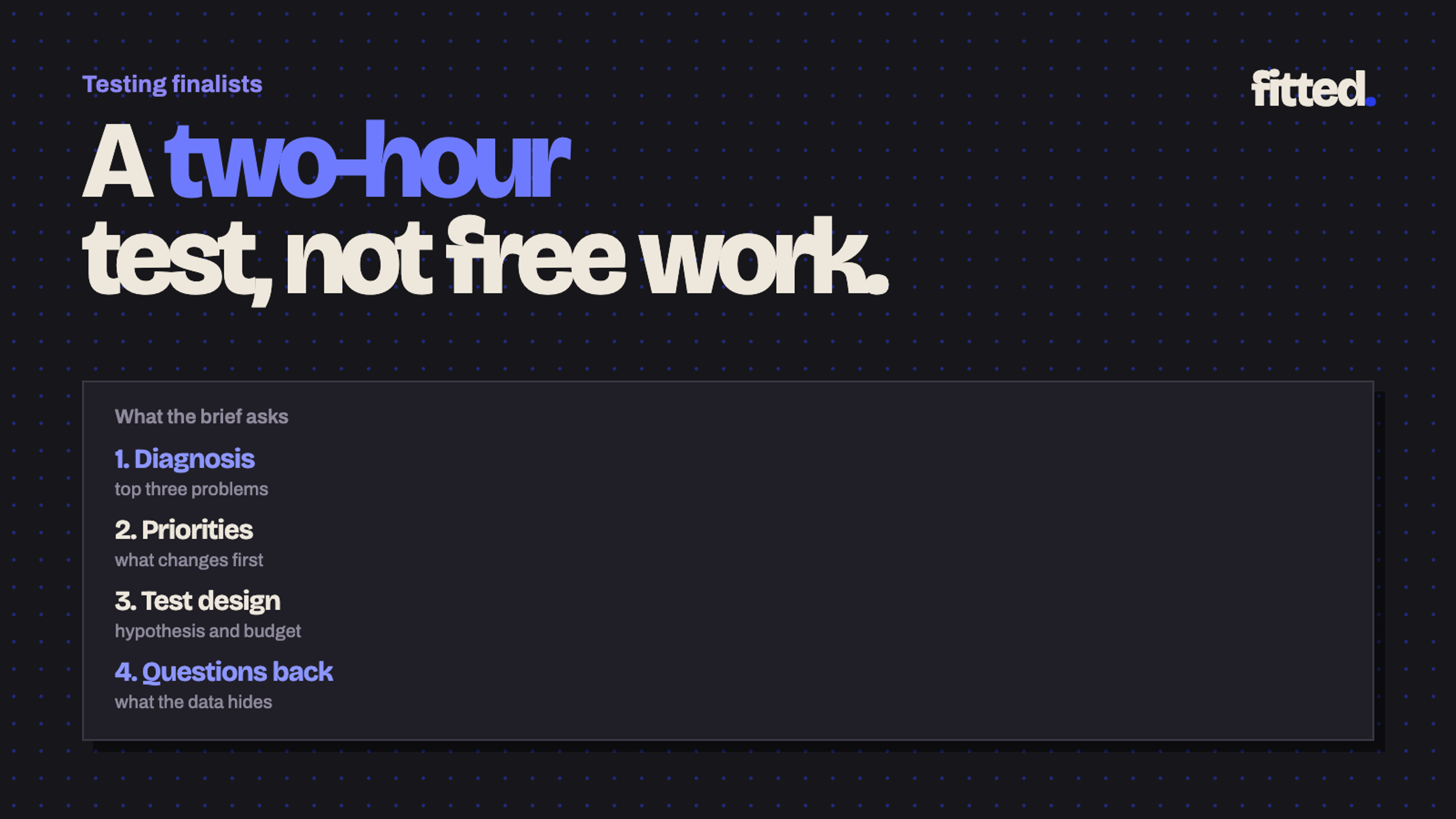
The paid media test assignment: how to run one candidates respect
A good test shows how a media buyer thinks in two hours. A bad one is free consulting. How to design a paid media test assignment that works.
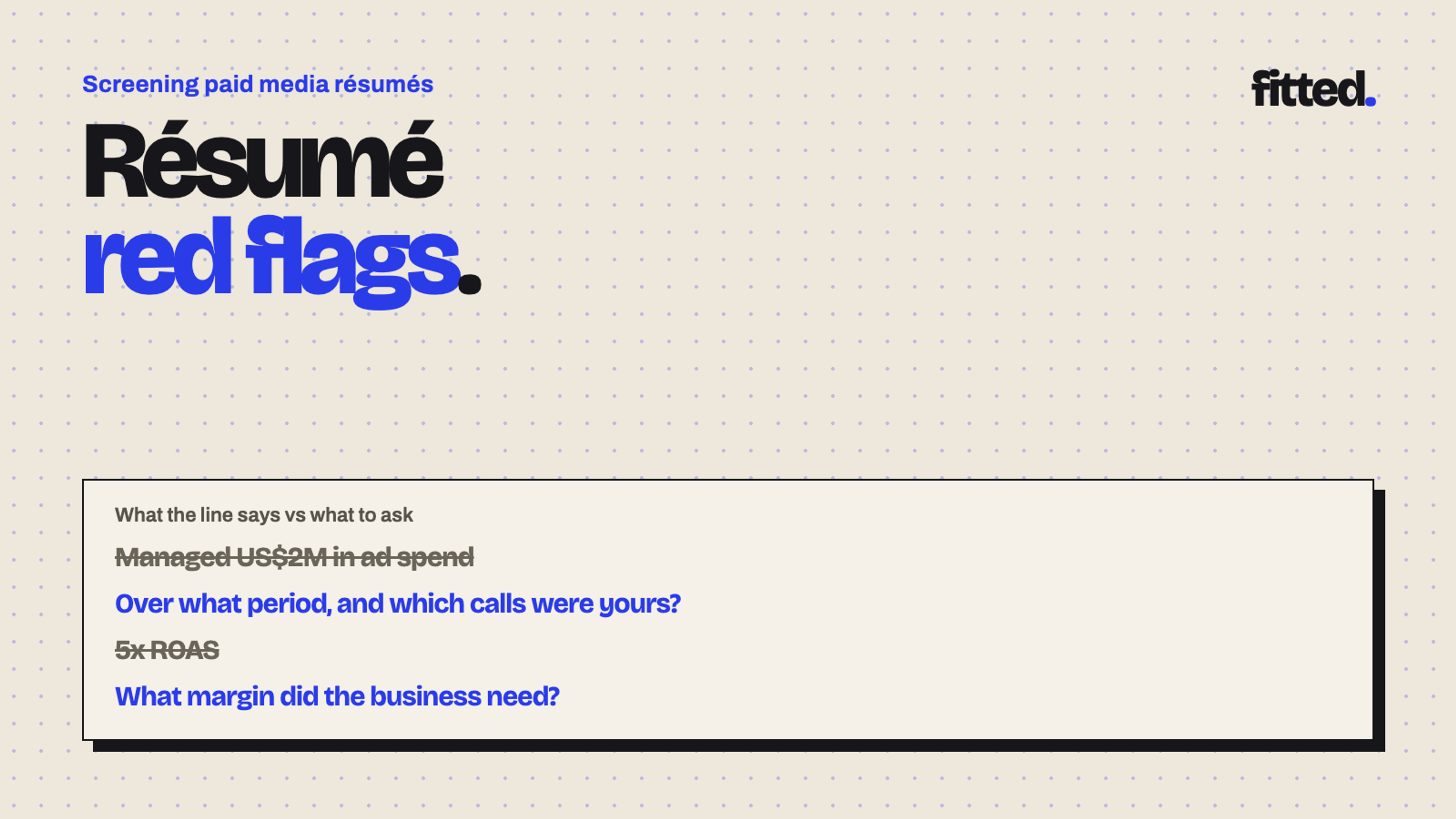
Paid media resume red flags: what to question before the interview
"Managed US$2M in ad spend" tells you nothing. Seven paid media resume red flags and the one question to ask about each.
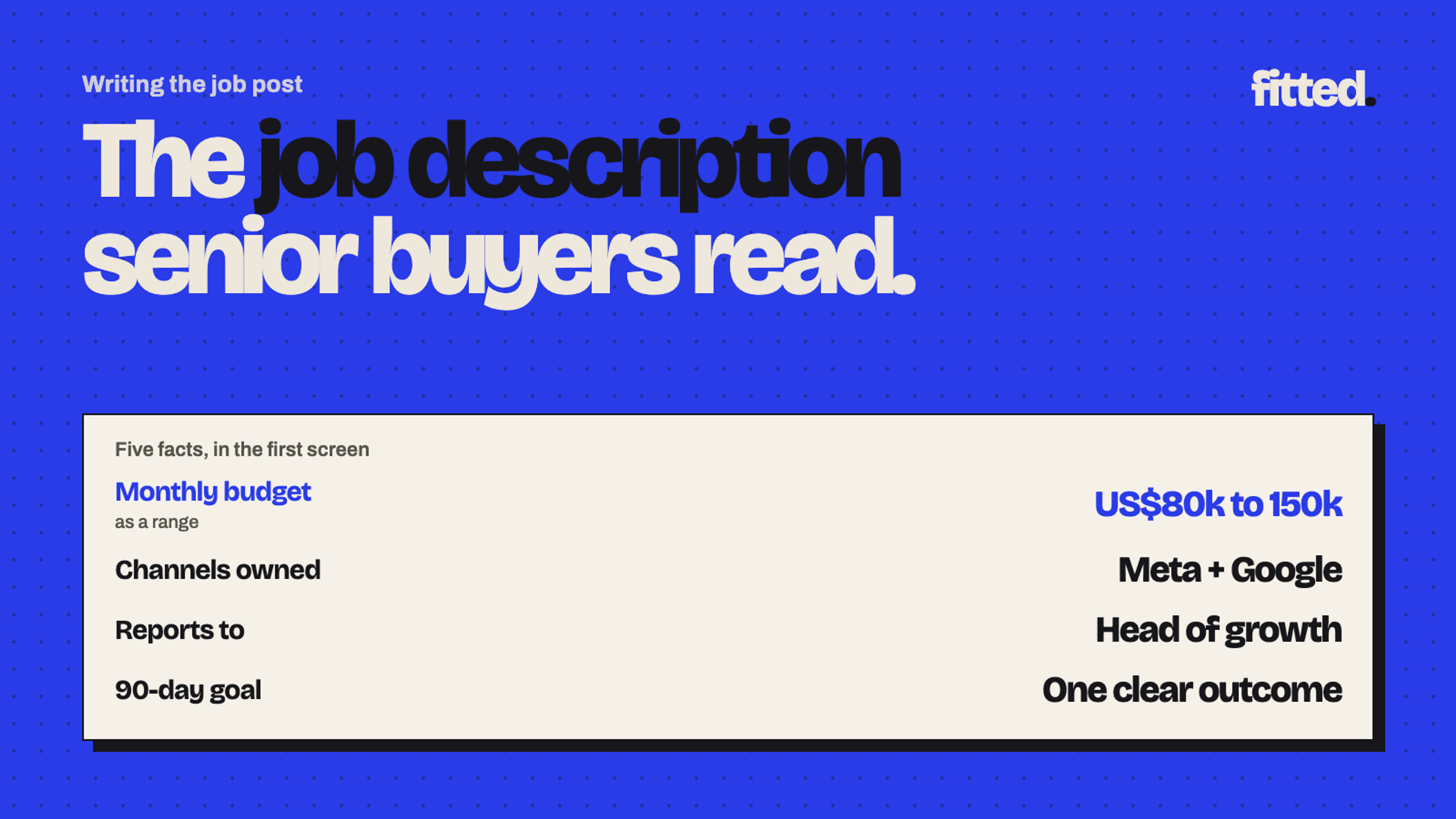
How to write a media buyer job description that attracts senior candidates
Most media buyer job descriptions list tools and skip the job. A template that tells senior candidates what they will own, spend and decide.